How do South teachers feel about the imminent cell phone ban instituted by the governor, Tina Kotek?
Executive Order 25-09 is intended to alleviate mental health issues, increase safety, and improve student outcomes by preventing the use of personal electronic devices the entire school day. What do teachers and staff think about the ban?
South principal Kee Zublin understands the idea behind it.
“There’s a recognition that cell phones have not been great for students’ mental health and have resulted in distractions as well as conflict between students,” Zublin said. “That is the goal of what the governor is doing. I think it’s going to be difficult. It will create some interesting conundrums for us that we’ll need to sort through.”
Some of those interesting conundrums include how the school will prevent the use of phones during lunch, and if they should at all. Zublin thinks that the policy will not result in closed lunch, alleviating some students’ fears. IHS teacher Devin Fahsholz expressed concerns surrounding the effects of the policy on students.
“Students who rely on school provided breakfast or lunch might be peer or socially pressured to skip those meals so that they can be on their phone more often,” Fahsholz said.
While it might be beneficial to limit phone use during lunch and break, Fahsholz is still unsure how 4j will execute the order.
“Based off of the feedback that I’m sure she [Tina Kotek] has already received,” Fasholz said, “it’s going to go towards a beginning of class to end of class policy, and that we will give up on trying to prevent students from using their phones between classes or lunch.”
Zublin agrees with Fahsholz’s uncertainty.
“[Executive Order 25-09’s] specific wording created a requirement that goes beyond what I would imagine we would have chosen for ourselves, which is that the bans will be in effect during lunch,” Zublin said. “We’re not yet at a place where I can quite imagine students being able to put their phones away for the entire school day.”
The way the order is formatted might be a bit strict, but in some staff’s opinion having one coherent policy is much better than other, differing, policies.
“I think some students like teachers who are less strict with their policy because they get to use their phones more often,” Fahsholz said. “I would think any student who truly has their best interests at heart would rather have something that’s uniformly the same.”
It seems Fahsholz is not alone in his opinions.
“The clarity of it will be helpful, and I do think it will be consistently applied across our district,” Zublin said.
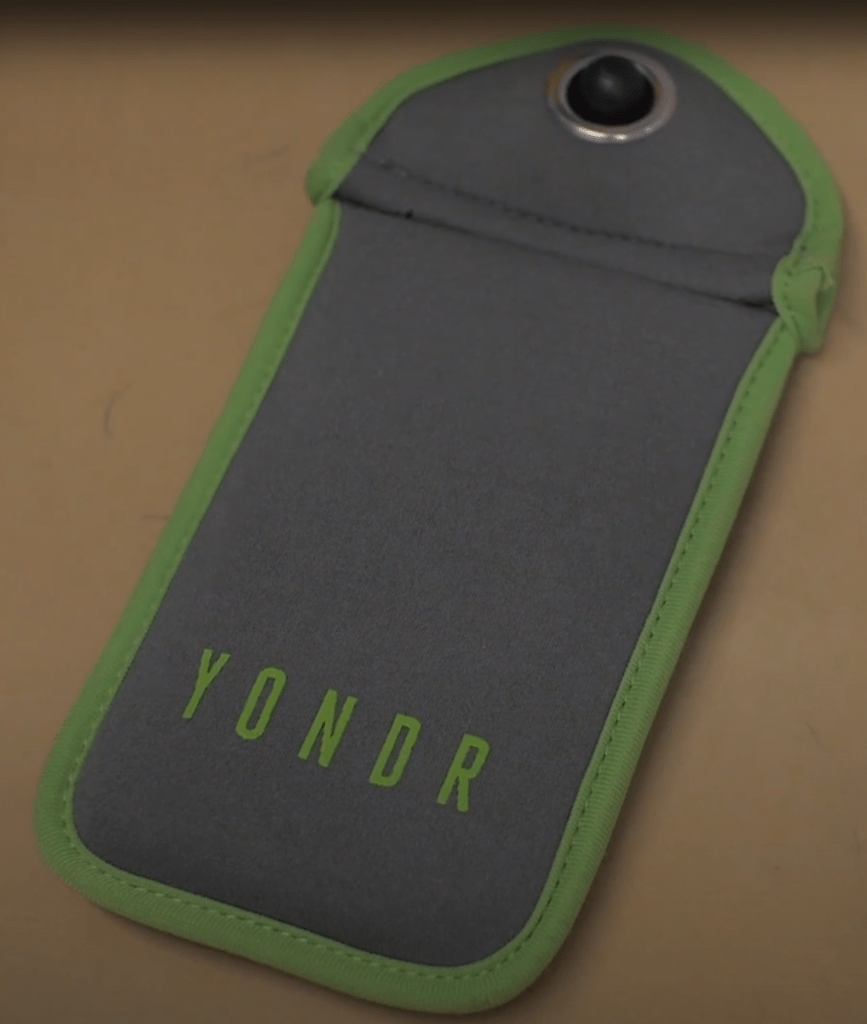
Yondr Pouch
However, there are some teachers who don’t share these ideas.
“I honestly am pretty skeptical that it’s not still gonna boil down to teachers having power struggles or not choosing power struggles with kids for their cell phones,” science teacher Dani Tubman said.
Another concern forwarded by students was how the ban will affect students with special needs, such as 504 plans or IEPs.
“There are legitimate medical reasons for some students to continue to use their phones,” Zublin said.
However, he stated that some accommodations will be reconsidered during the implementation of the ban. Fahsholz felt it was important to “not avoid solving the issue because of those small [complications].”
Yondr pouches, small, magnetically locking holders, are a possible, but expensive, solution. “I don’t think we’re going to be able to afford Yondr pouches,” Tubman said.
Zublin expressed similar uncertainty, and wasn’t sure which way the district would go.
There is only one real solution to phones in school, Fahsholz said,
“I guess I’d rather just talk to the parents and say don’t buy your kids a smartphone… They do not need to have the internet at their disposal 24/7.”
Photo from Wikimedia Commons
Article by Emmett Coughlan
 The Axe