
At the start of this school year, students were presented with a school cell phone policy that defaults to phones being put away or kept out of class for the entire period.But do students and teachers think that a stricter phone policy is the right move? South teachers are also using new and old methods to curb phone use and to keep students focused while learning.
“I don’t really think it has any effect on it,” South junior Adam Litt said. “It’s kind of neutral, my phone doesn’t really bother me.”
As phone policies get stricter at South, students don’t believe that the changes have helped their in-school performance. Studies have repeatedly shown that students scored higher on tests when their phones were in their backpacks compared to being in their pockets or on a table.
This summer, Oregon Gov. Tina Kotek spoke about a need for greater action from the state regarding phones in schools.
“I think this is an important enough issue that this should be a statewide approach,” Kotek said in an interview with OBP. “It’s very difficult for our educators to be able to do their job when students are on their devices.”
No official phone legislation has been created for Oregon schools yet, so making phone policies is still up to schools and school districts.
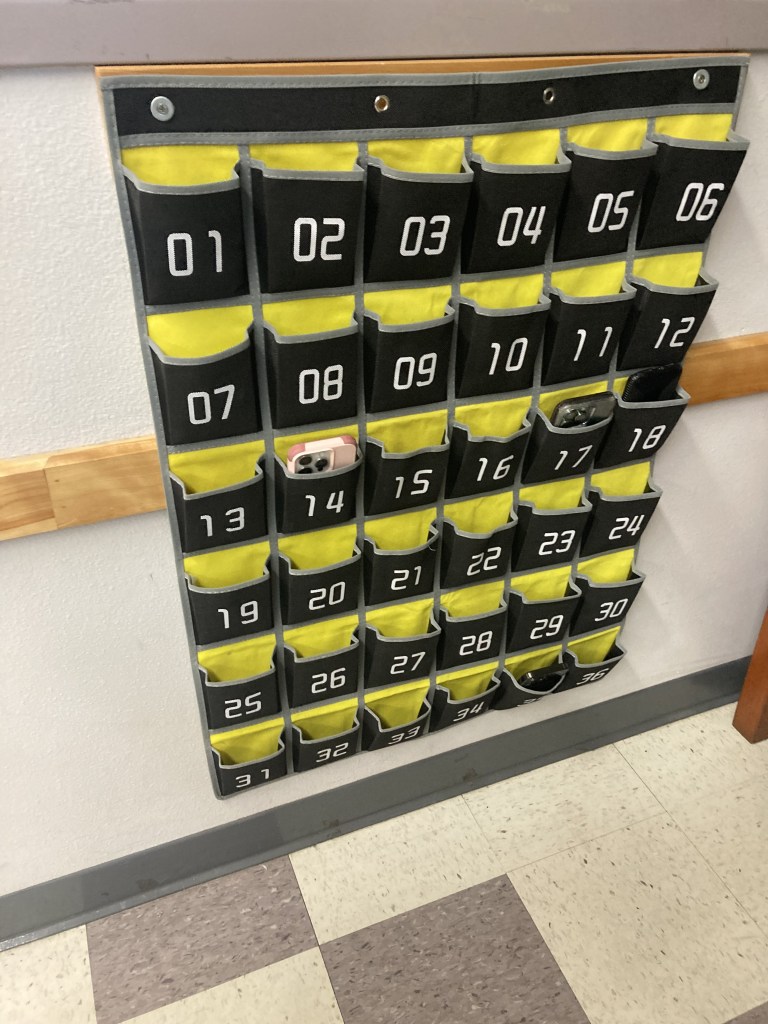
Students have another gripe with a specific way that some teachers are using to control phone use: cell hotels. Specifically, some students worry about not being able to access their phones during emergencies.
“What if there was an emergency and for some reason, you needed your phone?” South sophomore Madeline Moore questioned.
After various emergencies here at South and more immediate national incidents such as the deadly school shooting at Apalachee High School in early September, a need for students and parents to be able to communicate during emergencies has remained a top priority for many.
“I’d like to have access to my phone if there is an emergency,” Litt commented, “Having it in your backpack is fairer than having it in a hotel.” The updated phone policy leaves the choice to use cell hotels up to teachers. Even among teachers, the use of phone hotels remains an issue where many are split.
“They [students] were all very clear about the fact that [they] don’t mind putting [their] phones away,” South English teacher Madison Billings recounted. “The problem is when you take it off of my person, now it has become this issue between us … I’m already coming into the room feeling like it’s combative.”
Some teachers disagree with this view, arguing that students being able to keep their phones on their person always poses a possible risk to their learning. Even if you’re managing your phone use, research has indicated that “the fact that you’re managing it takes attention,” “If your phone is in your backpack, it’s still more of a drag in your attention, even if you’re not doing anything, than if it’s in another room,” South science teacher Asher Tubman said.
In previous years, incorporating phones into lessons was also seen as a possibility, but it appears to have fallen out of favor this year.
“I think that all of the positives that can come from good use being made of phones don’t address the fundamental barrier that they present,” Tubman remarked. “No amount of good apps for science or math is going to change the fact that your phone is how your friends say hi to you.”
Overall, teachers agree that phone use remains damaging to student’s learning.
“Ultimately, I want the time that we spend in here to feel useful and valuable, and when students take out their phones, they’re devaluing that time,” Billings said.
School administrators will need to wait for assessments, grading and other data collection to see if the new policy brings concrete shifts in academic performance. Until then, the rollout of the new phone policy will continue as one of numerous strategies to keep students engaged in instruction and learning.
Article by Oscar Guillemin
 The Axe