
As the November election approaches, seven swing states willl prove pivotal in deciding the nect U.S. president.
As the 2024 United States Presidential Election draws near, seven states hold the keys to the White House. While this year’s presidential race has been a whirlwind of wild twists and turns – from President Biden’s surprise withdrawal to multiple assassination attempts on former President Trump – the deciding factor remains the same as in the last two elections: several thousand votes in battleground states.
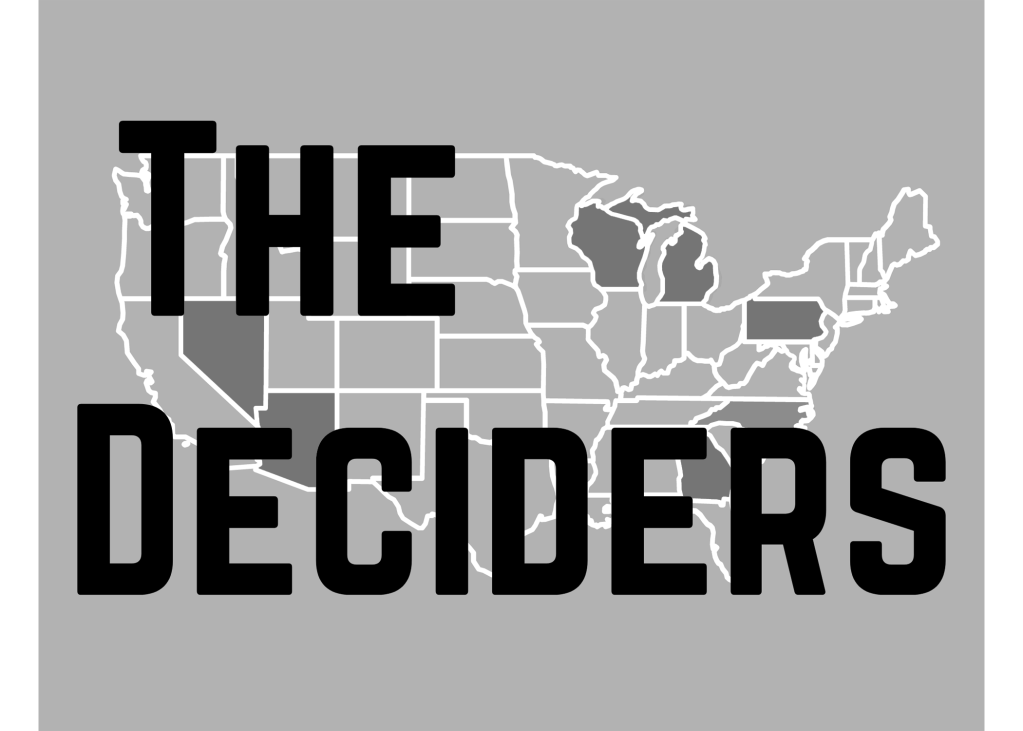
What is a swing state?
While both Republican and Democratic candidates have states that they can rely on for votes, some states are too close to call. A swing state is a state where major party candidates receive similar levels of support, meaning that they could be reasonably won by either party. These states are key to deciding the outcome of a close presidential election.
The Seven Swing States of 2024
Arizona – 11 electoral votes, Biden won by 10,000 votes in 2020
Though for decades Arizona has been considered red, Biden narrowly flipped the state in 2020. Arizona borders Mexico for hundreds of miles, and, as such, immigration issues and border control are top priorities for voters. Immigration also consistently ranks as a top issue for voters nationwide. According to Pew Research Center, around six in 10 American voters assert that immigration policy is important to their vote.
Georgia – 16 electoral votes, Biden won by 13,000 votes in 2020
Many of this year’s swing states align with the places where Trump-backed Republicans attempted to overturn Biden’s narrow win in 2020, and Georgia is no exception. A grand jury in Georgia’s own Fulton County indicted Trump for alleged election interference in 2023 – one of his four criminal prosecutions. Additionally, Georgia has the second largest African American population in the United States, following Texas. This voter base was believed to be key in securing Biden’s 2020 election win. While many black voters feel disillusioned with the Biden administration, the Harris campaign hopes to rally this demographic to assist another Democratic win.
Michigan – 15 electoral votes, Biden won by 150,000 votes in 2020
Before Trump’s 2016 election win, Michigan had voted reliably blue for years. However, Biden won back the state for Democrats in 2020. Michigan hosts the country’s largest proportion of Arab Americans who, alongside many young voters, continue to express concerns with the Biden administration’s actions regarding the Israel-Hamas War.
Nevada – 6 electoral votes, Biden won by 34,000 votes in 2020
Nevada has fewer electoral votes than any other state on this list, but the state could play an important role in the outcome of the election. Notably, Nevada has a large non-white population: around 40 percent of eligible voters are Latino, Black, or Asian American and Pacific Islander. Harris leads in all of these demographics, but Trump may have an edge in issues related to immigration and the economy.
North Carolina – 16 electoral votes, Biden won by 74,000 votes in 2020
Following Harris’ successful Democratic nomination, polls have become close in the Sun Belt state. Changing demographics – increases in white, college-educated voters and the Latino, Black, and Asian populations – have led to North Carolina being decided by less than two percentage points in elections since 2008, and the state appears to be “up-for-grabs” this election year.
Pennsylvania – 19 electoral votes, Biden won by 82,000 votes in 2020
Pennsylvania has the most electoral votes of any swing state, and both the Harris and Trump campaigns are focusing heavily on voters there. It is also the state where Trump survived his first assassination attempt. While in 2016, Trump’s populist messaging appealed greatly to white, middle-class voters without college degrees, Biden took the win in 2020, often highlighting his connection to the working class in his hometown of Scranton, Pennsylvania.
Wisconsin – 10 electoral votes, Biden won by 21,000 votes in 2020
Wisconsin is known to be unpredictable, and the state picked the winning presidential candidate in both 2016 and 2020. Experts suggest that third party candidates make the biggest splash in competitive states like this one where their policies may appeal more to voters than those of the two major candidates. As such, previous polls indicate that a significant amount of support for third-party candidate Robert F. Kennedy Jr. may have harmed support for both Harris and Trump. Kennedy endorsed Trump after suspending his campaign in late August. Meanwhile, Democrats hope to remove Green Party candidate Jill Stein from the ballot, citing legal issues. In 2016, Jill Stein received more votes in Wisconsin than Trump’s margin of victory, which may have facilitated the former president’s win.
Article by Lily Yao
 The Axe